In August, I had the opportunity to attend IJCAI-ECAI 2026 in Bremen, representing the AML Lab, Lamarr Institute, and University of Bonn.
On Friday, August 21, I presented our paper, Knowing When Not to Predict: Self-Supervised Learning and Abstention for Safer DR Screening, in the AI and Health Special Track.
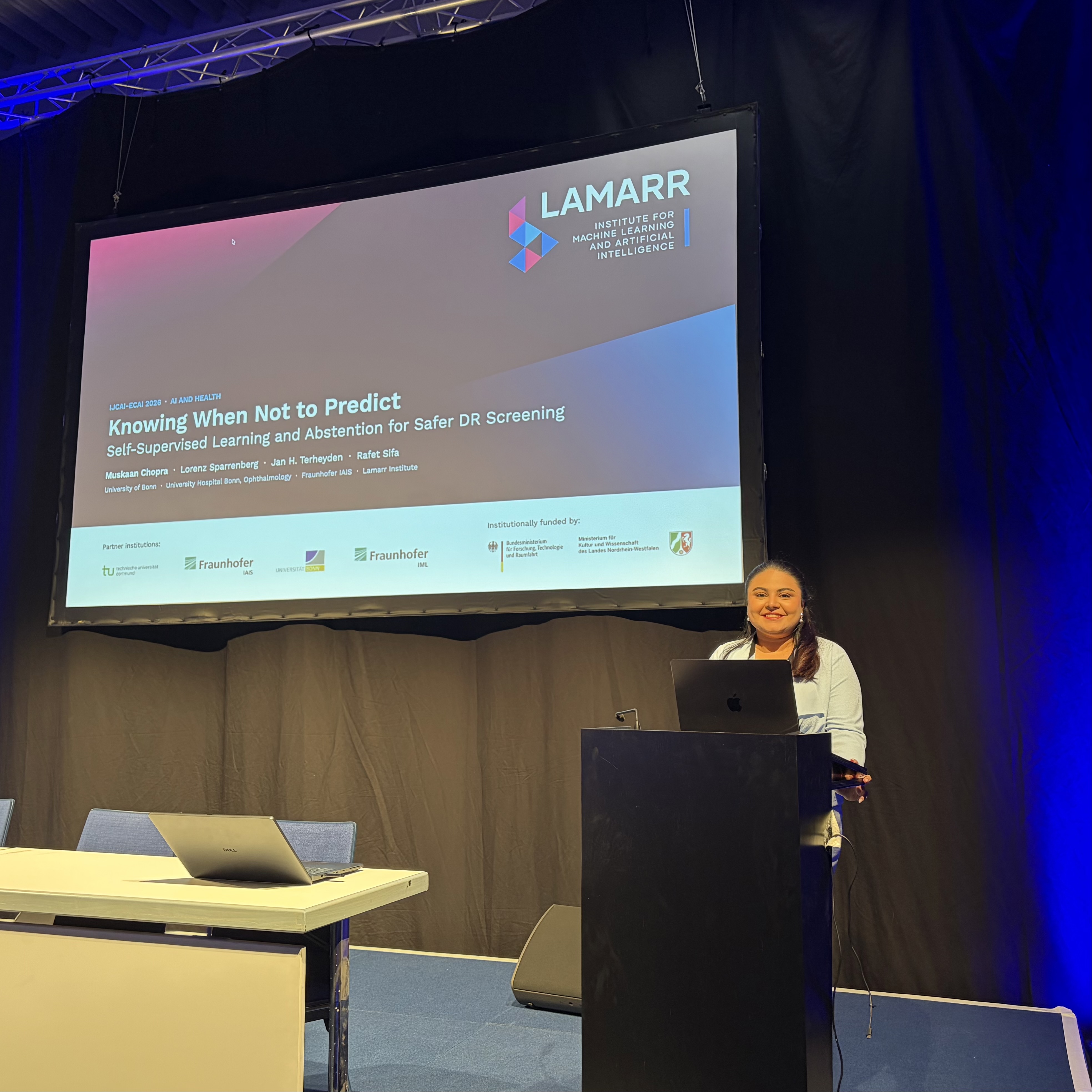
The work, co-authored with Lorenz Sparrenberg, Jan H. Terheyden, and Rafet Sifa, studies an important question for reliable medical AI: when should a model choose not to make a prediction?
Using diabetic retinopathy screening as our application, we investigate how self-supervised pretraining influences not only conventional predictive performance, but also the model’s behaviour when it is allowed to abstain on uncertain cases. Our results show that longer self-supervised pretraining does not necessarily lead to more reliable selective predictions. While conventional performance can saturate relatively early, selective performance can continue to vary across checkpoints.
This highlights the importance of evaluating AI systems beyond accuracy alone, particularly in safety-critical settings where identifying uncertain cases and referring them for expert review can be just as important as making the correct prediction.
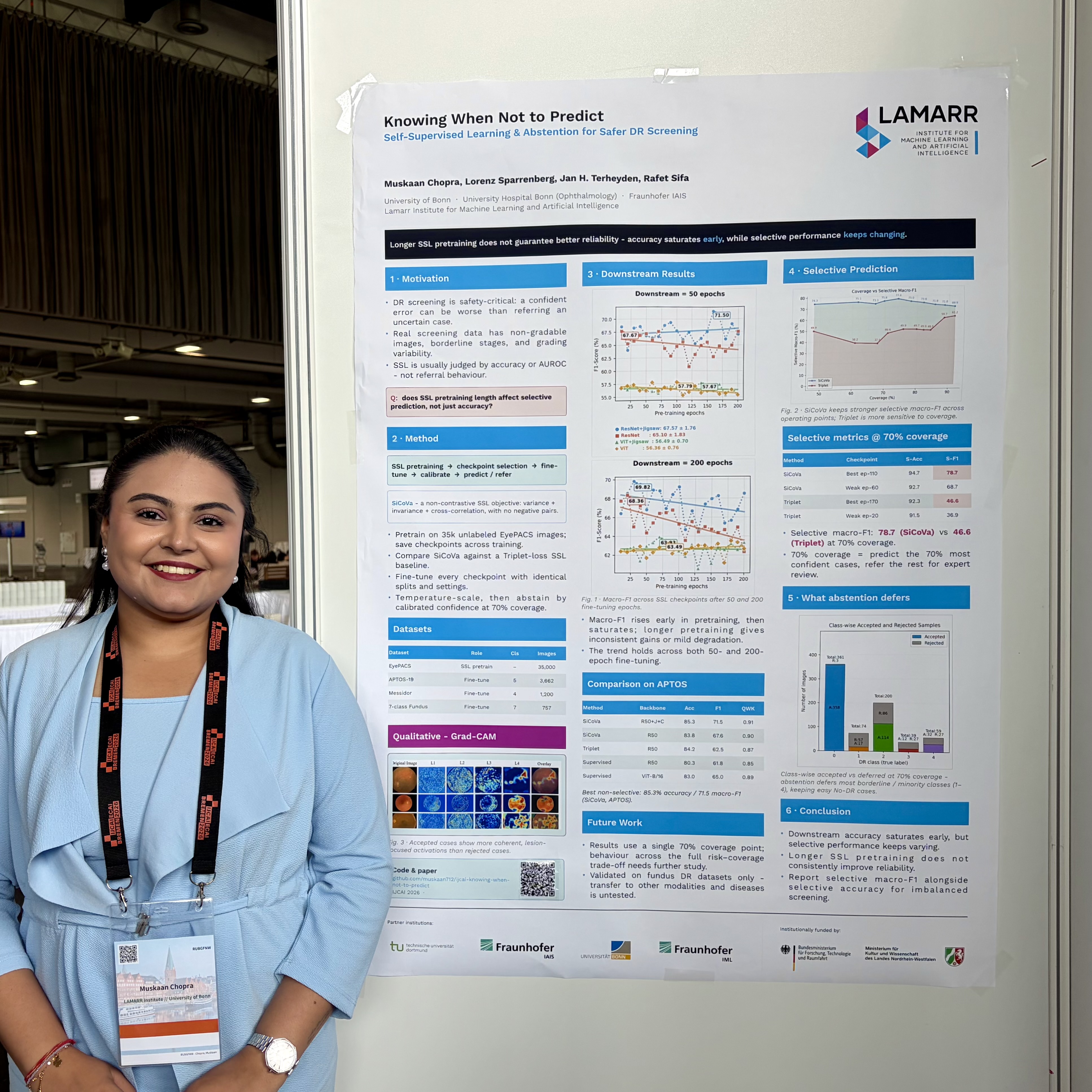
Beyond presenting our work, the week gave me the chance to attend keynotes and technical sessions and to have many interesting conversations across different areas of AI, including trustworthy AI, medical imaging, large language models, and machine translation. These discussions also gave me several new ideas and research questions to take forward.
I am especially grateful to my co-authors for all the work that went into this project. Overall, IJCAI-ECAI 2026 was a valuable week of presenting, exchanging ideas, and connecting with researchers across the AI community.