From Theory to Practice: Special Session on Large Language and Foundation Models
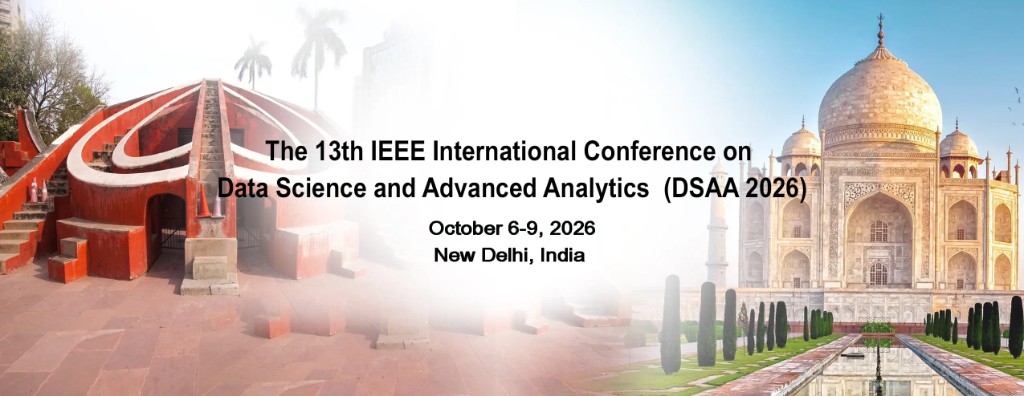
Location: Pride Plaza Hotel, Aerocity, New Delhi, India
Conference: DSAA 2026 (IEEE International Conference on Data Science and Advanced Analytics)
Date: October 8, 2026 (Indian Standard Time, IST / UTC+5:30)
Foundation models and large language systems have become indispensable technologies in data science and analysis, opening up powerful possibilities in the areas of text generation, knowledge extraction, and complex decision-making. This special session bridges the gap between theoretical breakthroughs and practical applications, creating a platform for researchers and practitioners to present innovative methods, exchange deployment strategies, and discuss actionable insights. By focusing on both technology and practical challenges, the session promotes interdisciplinary exchange, drives research momentum, and identifies effective approaches for embedding large language models in data-driven applications across various fields.
- Submission deadline: June 07, 2026
- Paper notification: August 10, 2026
- Camera-ready: August 30, 2026
- Contact:
amllab@bit.uni-bonn.de
Aims and Scope
This special session examines the deployment of large language and foundation models across diverse application areas:
- Showcase state-of-the-art developments in model architecture, optimization, and computational approaches.
- Present practical implementations and challenges encountered when adopting large language models in industrial applications.
- Enable interdisciplinary collaborations that merge fundamental research insights with operational deployment strategies.
- Provide a collaborative space to deliberate on ethics, privacy, social impact, and compliance requirements stemming from large language and foundation model implementations.
Agenda
Session start: 11:30 IST. Session moderator: Priya Tomar.
All agenda times are in Indian Standard Time (IST, UTC+5:30).
| Time (IST) | Type | Title | Presenter |
|---|---|---|---|
| 11:30-11:45 | Introduction | Opening remarks | Prof. Dr. Rafet Sifa & Dr. Linsey Pang |
| 11:45-12:30 | Keynote | The Operating System for AI-Native Enterprises | Avinash Karn |
| 12:30-13:30 | Lunch break | ||
| 13:30-14:45 | Keynote | Towards Trustworthy and Scalable Graph Foundation Models | Dr. Sandeep Kumar |
| 14:45-15:00 | Paper | ChatGIT: Intent-Aware Routing for Multi-Turn Conversational Code Retrieval | TBA |
| 15:00-15:15 | Paper | Towards Empathetic AI: MITI-Guided Evaluation of Large Language Models for Motivational Interviewing | TBA |
| 15:15-15:30 | Paper | ZoneGate: Per-Zone Deployment Readiness for Vision-Language Models in Industrial CCTV | TBA |
Keynotes
The Operating System for AI-Native Enterprises: From Experimentation to Agentic Transformation
Avinash Karn, Senior Director, AI Strategy, PayPal
Avinash Karn is Senior Director of AI Strategy at PayPal, where he leads AI strategy and engineering within PayPal’s central AI group and builds AI products, both customer-facing and internal, that shape how the company operates in the age of Agentic AI. His portfolio spans Business AI Transformation programs that tie AI investment to measurable business outcomes; Agentic Commerce, positioning PayPal as the economic operating system for the agent economy; an AI Fluency Index measuring enterprise adoption maturity; and foundational AI Research advancing PayPal’s frontier AI capabilities. Avinash built the measurement science that gives leadership confidence in AI ROI. A first-principles, frameworks-driven leader, Avinash sits at PayPal’s leadership table on AI positioning and competitive strategy, and shapes academic and industry dialogue across India on the future of AI-native enterprises.
Abstract: Large language models have lowered the barrier to enterprise AI experimentation, but for most organizations, the real challenge is now transformation, not experimentation. Moving from isolated pilots to AI-native operating models demands new ways of working, new organizational capabilities, and new architectural foundations. Drawing on practical experience at PayPal, this keynote explores scaling AI adoption through workforce fluency, platform democratization, internal AI champions, and measurable organizational enablement, and how initiatives were prioritized around business outcomes across finance operations, conversational platforms, workflow automation, and emerging agentic systems. The talk also covers the technical and operational realities of deploying enterprise-scale AI in regulated environments: orchestration frameworks, semantic caching, memory architectures, evaluation systems, governance, and production deployment, before outlining emerging patterns for AI-native enterprises, where reusable AI capabilities become foundational primitives that move organizations from AI-assisted work toward increasingly autonomous, adaptive operating models.
Towards Trustworthy and Scalable Graph Foundation Models
Dr. Sandeep Kumar, Associate Professor, IIT Delhi (Electrical Engineering and Yardi School of AI)
Dr. Sandeep Kumar is an Associate Professor in the Department of Electrical Engineering and the Yardi School of Artificial Intelligence at the Indian Institute of Technology Delhi, where he leads the Machine Intelligence Signals and Networks (MISN) Lab. He holds the Pankaj Gupta Chair Professorship in Privacy and Decentralization. His research spans graph machine learning, trustworthy and scalable AI, optimization, and foundation models, with applications in public health, finance, neuroscience, communication systems, and national security. He is Lead Investigator of Adi Vaani, a flagship initiative of the Ministry of Tribal Affairs developing multilingual AI for low-resource tribal and regional languages to advance digital inclusion and linguistic preservation. Through government and industry collaborations, his work combines rigorous algorithmic foundations with socially impactful AI systems.
Abstract: As AI moves into the foundation-model era, a central question remains: how can we reason over complex relational structure while keeping systems trustworthy, scalable, and efficient? While large models excel in language and vision, many real-world domains, from biology and finance to social networks and scientific discovery, are inherently graph-structured. This talk positions Graph Neural Networks (GNNs) and graph representation learning as a foundation for the next generation of reliable AI. The talk first examines the trust gap in graph machine learning, covering robustness, fairness, privacy, and uncertainty in large-scale relational systems, including recent advances in fairness-aware models, privacy-preserving learning, and robust representations for high-impact deployment. It then discusses Self-Supervised Learning (SSL) as a scalable path to graph foundation models, showing how SSL objectives learn transferable relational representations and support graph-language models that combine semantic understanding with structural reasoning. Finally, the talk addresses scalability through optimization-based graph coarsening, compression, and hashing-driven dimensionality reduction, along with graph-to-MLP distillation for efficient deployment. The talk outlines a roadmap toward graph foundation models that are powerful, trustworthy, scalable, and practical for real-world AI systems.
Organizers
Prof. Dr. Rafet Sifa (Contact Person)
University of Bonn, Germany · rafet.sifa@bit.uni-bonn.de
Prof. Dr. Rafet Sifa is a leading researcher in AI and machine learning, with over 15 years of experience and a
regular contributor to top-tier machine learning conferences. His research focuses on hybrid deep learning and large-scale
analytics, with extensive publications on both theoretical and applied machine learning topics with a deep focus on
representation learning. He co-organized the special session on Informed and Explainable Methods for Machine Learning
at ICANN 2019, the three workshops on foundational and large language models at IEEE BigData (2023, 2024, 2025), a
special session on Large Language and Foundation Models at IEEE DSAA 2025, and workshops on Bridging Neurons and
Symbols for NLP and Knowledge Graphs Reasoning at COLING 2024 and 2025.
Prof. Dr. Wei Liu
University of Technology Sydney, Australia · wei.liu@uts.edu.au
Wei Liu is an Associate Professor of Machine Learning and Director of the Future Intelligence Research Lab at UTS. He
holds a PhD in Machine Learning from the University of Sydney. His research spans generative AI, adversarial machine
learning, cybersecurity, game theory, multimodal learning, NLP, and intrusion detection. He has earned 3 Best Paper
Awards and a Most Influential Paper Award at PAKDD, and serves as senior PC member and area chair at KDD, AAAI, and
ICDM.
Dr. Dhaval Patel
IBM Research, USA · dhaval.patel@ibm.com
Dr. Dhaval Patel is a research scientist specializing in AI model optimization and industrial applications. His work
bridges fundamental research and real-world deployment, focusing on scalable machine learning solutions. He
co-organized the previous workshops on foundational and large language models at IEEE BigData as well as the special
session at DSAA 2025.
Dr. Linsey Pang
PayPal Inc., USA · panglinsey@gmail.com
Linsey Pang is a Distinguished Scientist at PayPal. Previously she was a Principal Machine Learning Scientist at Salesforce.
Prior to this, she was a Principal Data Scientist at Walmart Lab. Prior to joining Walmart Lab, she worked as an applied
scientist at eBay Inc. She finished her PhD degree in machine learning research at the University of Sydney. She
co-organizes multiple workshops and tutorials at CIKM, KDD, and WSDM in top data mining conferences.
Dr. Lorenz Sparrenberg
University of Bonn, Germany · lsparren@uni-bonn.de
Dr. Lorenz Sparrenberg’s research focuses on large language models and their evaluation, robustness, and limitations.
His recent work includes research on efficient inference of LLMs and empirical studies on their behavior in real-world
settings, as well as publications on representative learning for clinical and decision support applications including
dementia detection and diabetic retinopathy.
Priya Tomar
University of Bonn, Germany · ppriya@uni-bonn.de
Priya is a data scientist at Fraunhofer IAIS and a PhD candidate at the University of Bonn focusing on deep
learning-based medical image analysis, in particular Surgical AI. Her work addresses domain-specific challenges in the
surgical domain by developing data-driven and application-oriented methods to enhance clinical applicability. Her
recent publications focus on semantic segmentation for robot-assisted abdominal surgery.
Submission
To submit a paper to SSLLFM2026, go to OpenReview (IEEE DSAA 2026 Conference), and select the “Special Session: From Theory to Practice: Special Session on Large Language and Foundation Models” track when it is available.
The length of each paper submitted to SSLLFM2026 should be no more than ten (10) pages and should be formatted following the standard 2-column U.S. letter style of IEEE Conference template. For further information and instructions, see the IEEE Proceedings Author Guidelines.
All submissions will be double-blind reviewed by the Program Committee based on technical quality, relevance to the special session’s topics of interest, originality, significance, and clarity. Author names and affiliations must not appear in the submissions, and bibliographic references must be adjusted to preserve author anonymity. Submissions failing to comply with paper formatting and authors anonymity will be rejected without reviews.
Because of the double-blind review process, non-anonymous papers that have been issued as technical reports or similar cannot be considered for SSLLFM2026. An exception to this rule applies to arXiv papers that were published in arXiv at least a month prior to SSLLFM2026 submission deadline. Authors can submit these arXiv papers to SSLLFM2026 provided that the submitted paper’s title and abstract are different from the one appearing in arXiv.
Call for Papers
The topics of interest are, but not limited to:
- Model Training and Optimization:
- Techniques to deal with hallucinations
- Training data for LLMs
- Efficient and stable techniques for training and finetuning LLMs
- Scalable approaches for distributed model training
- Middleware for scale out data preparation for LLM training
- Workflow orchestration for end-to-end LLM life cycle
- Resource management for compute and energy efficient model training
- Representation learning
- Model Utilization and Integration:
- Using LLMs effectively as tools for Reinforcement Learning or search
- Enhancing LLM capabilities by using external tools such as search engines
- Visual Prompt Tuning and in-context learning
- Enable easy experimentation with high utilization to train foundational models in the cloud
- Strategies to scale resources for training/fine-tuning foundational models
- Instruction tuning including generation of instruction tuning data
- Parallel training: data model tensor (attention and weights)
- Distributed workflows for data cleansing and model usage (LangChain)
- Principled AI
- Investigating reasoning capabilities of LLMs
- Retrieval Augmented Generation
- Alternative architectures such as State Space Models
- Compact Language Models and Knowledge Distillation:
- Knowledge representations for training small/compact language models
- Evaluation of different teacher-student distillation and model compression strategies
- Techniques for efficient data encoding to maintain linguistic properties in compact models
- Deployment of lightweight models in resource-constrained environments
- Case studies on the effectiveness in various NLP tasks
- Application-Specific Models:
- Math LLMs
- Multimodal Foundation Models
- Trustworthy Foundation Models
- Large-scale Visual Foundation Models
- Timeseries foundation models for forecasting, prediction and control
- Multi-Agent System using LLMs
- Recommender systems using LLMs
- Knowledge management using LLMs
- Knowledge Incorporation and Adaptation:
- Approaches to deal with knowledge recency to effectively update knowledge within LLMs
- Incorporating domain knowledge in LLMs
- Evaluation and Benchmarking:
- Additional benchmarks to fill gap between human and automatic reference-based evaluation
Proceedings and Indexing
All accepted full-length special session papers will be published by IEEE in the DSAA main conference proceedings under its Special Session scheme. All papers will be submitted for inclusion in the IEEEXplore Digital Library.
Previous Editions
- SSLLFM 2025 (Special Session at IEEE DSAA 2025, Birmingham, UK. 35 submissions, 8 accepted papers, 60+ participants.)
- WLLFM 2025 (Workshop at IEEE BigData 2025, Macau SAR, China. 29 submissions, 5 accepted papers, 50+ participants.)
- WLLFM 2024 (Workshop at IEEE BigData 2024, Washington DC, USA. 55 submissions, 19 accepted papers, 100+ participants.)
- WLLFM 2023 (Workshop at IEEE BigData 2023, Sorrento, Italy. 31 submissions, 11 accepted papers, 50+ participants.)