On 29 October 2026, we presented our paper, “FARABI at WMT 2026: Post-Hoc Channel Controllers for Low-Resource Arabic–Asian Machine Translation,” at EMNLP 2026 in Budapest. See here for the paper in the WMT 2026 proceedings.
Our work was part of the WMT 2026 Low-Resource Arabic–Asian Machine Translation shared task, covering ten translation directions between Arabic and five languages: English, Hindi, Bengali, Indonesian, and Urdu. With approximately 20,000 parallel training sentences per language pair, the task provided an opportunity to investigate how multilingual translation models can be adapted effectively in low-resource settings.
Our FARABI System
We developed FARABI using two multilingual backbone models: NLLB-200 (3.3B) and Qwen2.5-7B-Instruct, combined with different adaptation strategies.
For translation into Arabic, we jointly fine-tuned NLLB-200 on all five source languages. This allowed the model to benefit from shared multilingual representations while using a single fine-tuned backbone. We then applied NTK-Mirror, a lightweight post-hoc controller, separately for each translation direction.
For translation from Arabic, we explored Qwen2.5-7B-Instruct with QLoRA, together with NTK-Mirror controllers. We also investigated alternative configurations, including zero-shot NLLB-200 and retrieval-augmented translation.
The central research question was whether we could improve translation quality after backbone adaptation, without further updating its weights.
NTK-Mirror addresses this by selecting 5,000 layer–channel pairs based on their activation magnitudes and learning a small scaling parameter for each. These parameters adjust internal activations while leaving the backbone frozen, making the controller substantially smaller than conventional fine-tuning adapters.
Official Shared-Task Results
Our FARABI primary submission ranked among the top three teams in all five into-Arabic translation directions, achieving first place for Bengali-to-Arabic and Indonesian-to-Arabic, second place for Hindi-to-Arabic and Urdu-to-Arabic, and third place for English-to-Arabic.
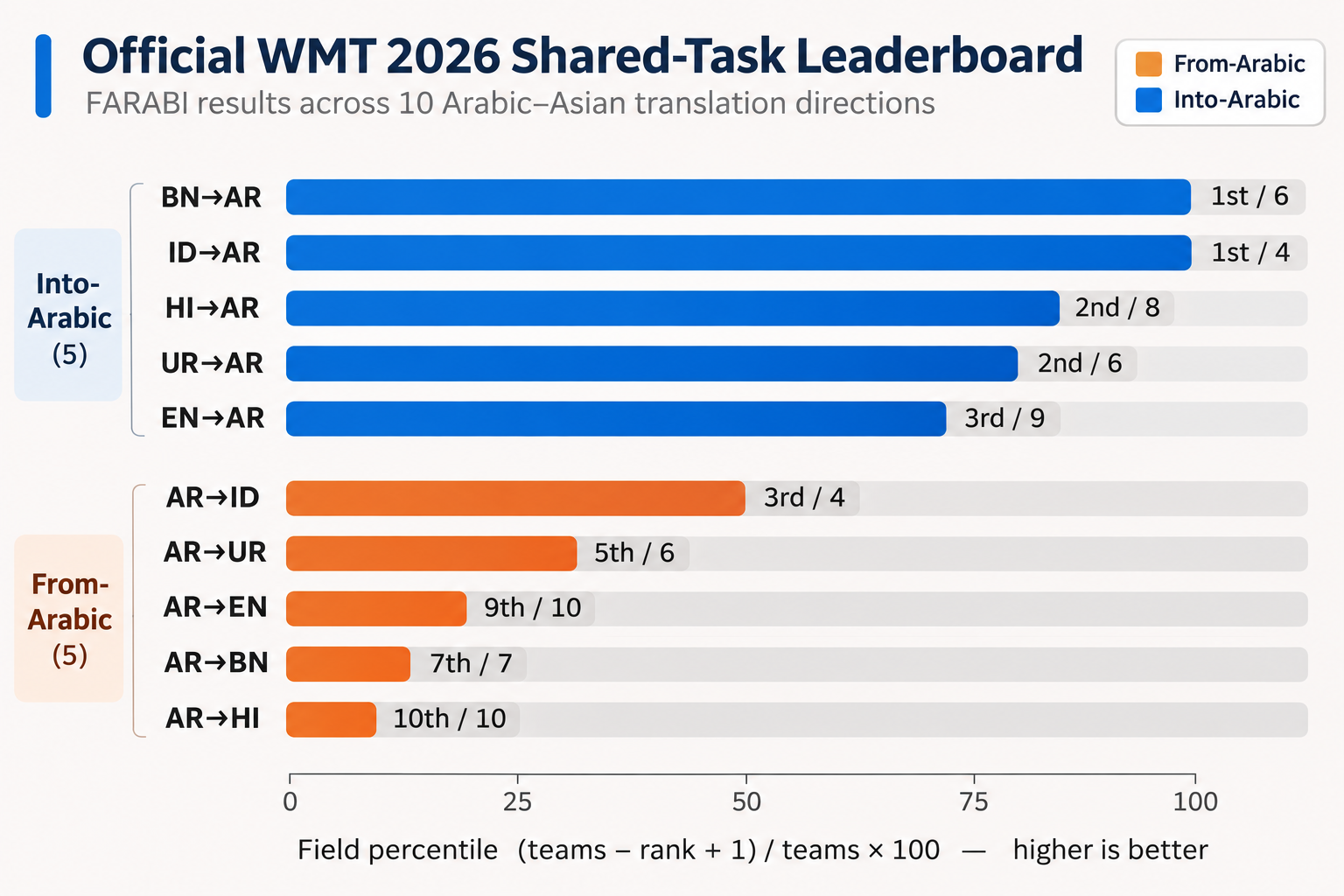
Official WMT 2026 challenge-test rankings and BLEU scores for FARABI’s into-Arabic submissions.
Evaluating NTK-Mirror
To investigate the contribution of NTK-Mirror, we compared our jointly fine-tuned NLLB-200 backbone with and without the controller.
NTK-Mirror improved BLEU in all five into-Arabic directions, with gains ranging from +0.21 to +0.65 BLEU. Four of these improvements were statistically significant according to paired-bootstrap testing.
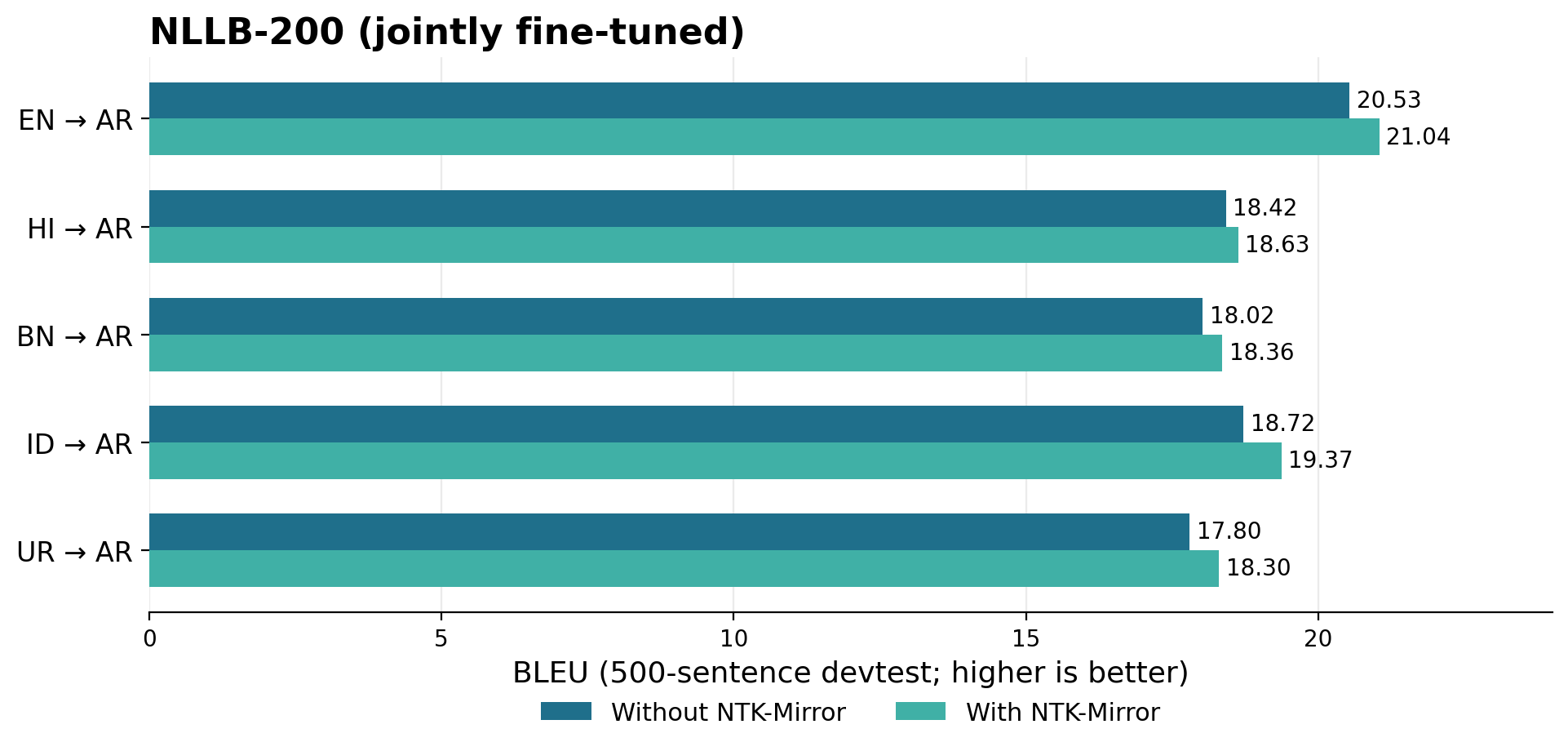
BLEU comparison on the 500-sentence devtest set. These results are separate from the official challenge-test leaderboard scores.
The experiments also revealed an important limitation: the effectiveness of NTK-Mirror depends on the underlying backbone and adaptation strategy. While the controller consistently improved the fine-tuned NLLB-200 system for translation into Arabic, its benefits were more variable with other configurations.
Our post-submission analysis further showed that backbone selection and direction-specific fine-tuning were especially important for translation from Arabic. Jointly fine-tuning NLLB-200 substantially narrowed the performance gap in those directions.
Overall, our findings suggest that lightweight post-hoc controllers can provide useful improvements with minimal trainable parameters, but they work best as a refinement of an already well-adapted translation model rather than a replacement for fine-tuning.